
Excess cash in the bank? Treasury Bills could be worth considering
When short-term yields become more attractive, liquidity itself becomes an asset that needs to be actively managed. For many years, Treasury Bills (T-bills) have been a popular choice for investors seeking a relatively secure and short-term home for their cash. However, their appeal diminished during the prolonged period of exceptionally low interest rates, when the returns available on short-term instruments offered investors little incentive to invest.
The interest rate environment has since changed significantly, bringing T-bills back into focus. With more attractive short-term yields, investors, businesses and institutions holding excess liquidity have greater reason to consider how their cash is being managed rather than simply leaving it idle.
In this article, we explain what T-bills are, how they work, why they have regained popularity, and the role they can play within a well-managed investment portfolio or liquidity strategy.
T-bills have a long history as a tool used by governments to meet their short-term financing requirements. Rather than issuing longer-term government bonds every time funding is required, governments issue short-dated securities that allow them to borrow for relatively brief periods, while providing investors with an opportunity to place surplus cash in government-backed instruments.
T-bills are generally considered to carry very low default risk. They also tend to be highly liquid, particularly in the larger sovereign markets, where there is broad institutional demand.
Unlike conventional bonds, T-bills do not normally pay periodic interest. Instead, they are issued at a discount to their face value, with the investor’s return representing the difference between the amount paid for the T-bill and the amount received at maturity. Their maturities are very short, typically ranging from a few weeks to one year.
These characteristics make T-bills particularly relevant for institutional investors, corporate treasury departments and individuals looking for somewhere to place excess liquidity for a relatively short period without taking on the duration risk associated with longer-term bonds.
What makes T-bills special?
Although T-bills are debt securities, their structure differs from that of most conventional bonds.
A typical plain-vanilla bond pays a fixed or variable coupon and repays its face value on a predetermined maturity date. T-bills, on the other hand, are zero-coupon securities. They are normally purchased for less than their face value and redeemed at face value at maturity.
For example, an investor purchasing a six-month T-bill with a face value of €250,000 and an annualised yield of approximately 2.65% would pay around €246,695. At maturity, the investor receives €250,000, resulting in a return of approximately €3,000 before taxes.
Another important characteristic of T-bills is their low sensitivity to changes in interest rates. Because the period remaining until maturity is so short, changes in market interest rates tend to have a much smaller impact on their value than they would on longer-dated bonds.
This is an important distinction. A bond with 10 or 20 years remaining until maturity can experience meaningful price movements when interest-rate expectations change. With a T-bill maturing within a few months, interest-rate risk is considerably lower, particularly if the investor plans to hold the security until maturity.
How do yields across Europe, the US and UK compare?
Historically, the euro area has generally experienced lower economic growth and inflation than the US and, at various points, the UK. This has contributed to periods of lower interest rates and lower yields on euro-denominated government securities.
As I write this article, the yield on a 3-month German T-bill stands at 2.51%. The equivalent yields in the US and UK stand at 4.09% and 4.2% respectively.
In Malta, T-bills are issued regularly by the Treasury department through competitive auctions. Three and six-month maturities are among the more commonly issued tenors, although other maturities may also be offered depending on the Government’s financing requirements. For investors, this provides another potential avenue for managing short-term euro liquidity.
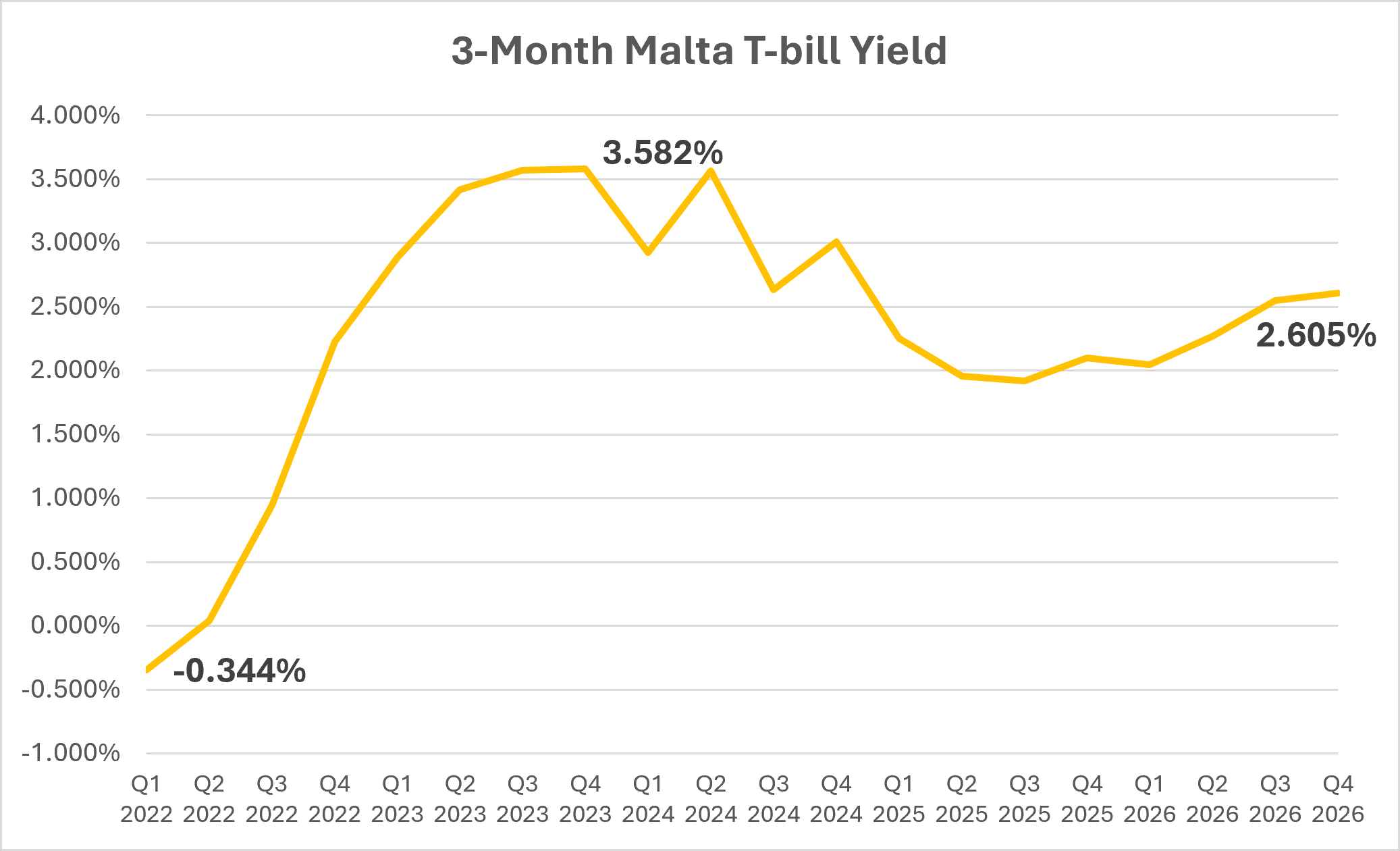
Why higher T-bill yields deserve attention
For institutional investors, corporate treasury departments and individuals holding excess liquidity, the important question is not simply “How much cash do I have?” but also “What is that cash earning?”
When short-term interest rates are relatively attractive, the opportunity cost of leaving substantial amounts of cash earning next to nothing becomes more significant.
T-bills can therefore be relevant because they combine short maturities, relatively low credit risk and the potential to generate a return on money that may otherwise remain idle.
Consider a company holding cash for future capital expenditure, tax payments, dividends or other commitments. It may need those funds in six months, but not necessarily tomorrow. The same principle applies to an individual holding a substantial cash balance that is unlikely to be required in the immediate future.
Rather than viewing the entire balance as cash that must remain immediately accessible, investors can consider separating their liquidity according to when it is likely to be needed.
The impact becomes increasingly noticeable, as the amount of excess liquidity grows. As a simple illustration, €500,000 earning 0.5% would generate approximately €2,500 over a year. At 2.5%, the equivalent annual return would be approximately €12,500, before taxes, fees and other costs.
Managing liquidity, not simply chasing yield
The attraction of T-bills should not, however, be viewed purely in terms of achieving a higher return. Effective cash management requires investors to balance return, liquidity, maturity and risk.
Money that could be required at very short notice may appropriately remain in a bank account or another immediately accessible instrument. Funds that are not expected to be required for three, six or twelve months, however, can potentially be managed differently.
One approach is to divide surplus liquidity across different maturities, sometimes referred to as laddering. Instead of investing the entire amount into a single maturity, an investor could spread funds across a series of T-bills maturing at different intervals. This creates regular opportunities for cash to become available while allowing other portions of the portfolio to remain invested.
When short-term yields are attractive, leaving substantial excess liquidity idle also carries an opportunity cost. For institutional investors, corporate treasury departments and individuals with significant cash balances, this makes it worthwhile to periodically review not only how much liquidity they hold, but also whether that liquidity is working efficiently while remaining available when it is needed.
Marketing Material: This article is intended for general information purposes only and does not constitute investment advice, an offer, or an invitation to buy or sell any financial instruments. Investments are subject to market fluctuations and the value of investments, and any income derived from them may rise or fall. Investors may lose some or all of their invested capital. Investment returns and income are not guaranteed. Past performance is not indicative of future results and any reference to potential returns, yields or investment outcomes should not be interpreted as a guarantee or expectation of future performance. Investors should seek appropriate professional advice and refer to the relevant product and service documentation before making any investment decision. Jesmond Mizzi Financial Advisors Limited is licensed to conduct investment services business by the MFSA under the Investment Services Act and is a member of the Malta Stock Exchange. The directors or related parties, including the Company and their clients, may have an interest in securities mentioned in this article.